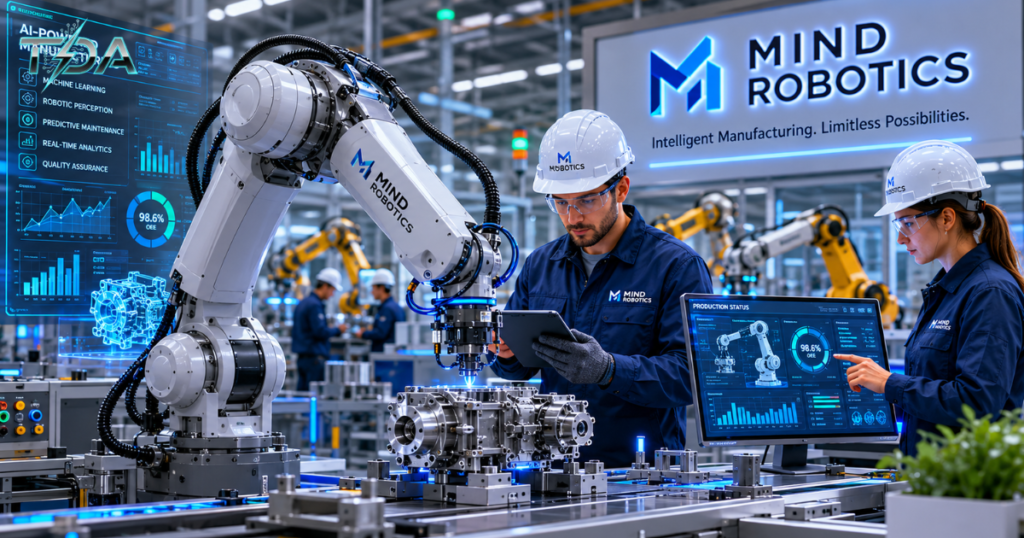
Mind Robotics is an industrial AI robotics company focused on bringing intelligence, adaptability, and automation to manufacturing environments. The company develops advanced robotic systems designed to work in real factories, helping manufacturers improve productivity, safety, and operational efficiency.
Unlike traditional industrial robots that perform fixed tasks in highly controlled environments, Mind Robotics combines artificial intelligence, robotic hardware, and manufacturing data to create systems capable of adapting to changing conditions. This approach allows robots to support a wider range of industrial tasks while working alongside human employees.
As manufacturing industries continue to face labor shortages, rising production demands, and increasing competition, intelligent automation is becoming more important than ever. Mind Robotics aims to address these challenges through AI-powered robotics built specifically for factory-floor deployment.
Today, the company is gaining attention from manufacturers, investors, and technology leaders because of its focus on practical industrial applications rather than consumer-focused robotics projects.
Why Mind Robotics Is Different From Traditional Industrial Robotics
For decades, industrial robots have been a valuable part of manufacturing. They excel at repetitive activities such as welding, assembly, and material handling. However, these systems often struggle when conditions change unexpectedly.
Modern manufacturing is rarely perfect.
Parts may arrive in different positions. Production requirements may change. New products may require adjustments to existing workflows.
Traditional automation often requires extensive reprogramming to handle these changes.
Mind Robotics takes a different approach by integrating AI-driven perception and decision-making capabilities into its robotic systems.
Instead of simply following predefined instructions, intelligent robots can analyze their environment and adjust their actions accordingly.
This flexibility can help manufacturers automate tasks that were previously difficult or impossible to automate using conventional robotics.
As a result, factories may become more efficient while maintaining the flexibility required in today’s competitive manufacturing landscape.
Mind Robotics Founder: Who Created the Company?
The Mind Robotics founder is RJ Scaringe, an entrepreneur and engineer known for building advanced manufacturing operations in the electric vehicle industry.
Over the years, Scaringe gained firsthand experience with the complexities of large-scale production. While observing factory operations, he noticed that many important tasks still depended heavily on human workers.
Although automation had improved many processes, numerous manufacturing activities still required dexterity, adaptability, and judgment.
This challenge inspired the creation of Mind Robotics.
Rather than relying on existing solutions, Scaringe believed a new approach was needed—one that combined artificial intelligence with industrial robotics to address real-world manufacturing challenges.
His vision was not centered on entertainment or robotics demonstrations. Instead, it focused on solving practical problems that affect manufacturers every day.
Mind Robotics CEO: Leadership Driving Industrial Innovation
As the Mind Robotics CEO, RJ Scaringe continues to guide the company’s long-term strategy and product development efforts.
His engineering background provides a unique perspective on the relationship between robotics and manufacturing. Under his leadership, the company has emphasized industrial deployment, operational efficiency, and practical value creation.
This manufacturing-first mindset influences every aspect of the business.
Rather than designing robots for household environments, the company focuses on production facilities where automation can create measurable economic benefits.
This strategic direction has helped position Mind Robotics as a serious player in the emerging industrial AI robotics sector.
Mind Robotics Headquarters: Where Is the Company Based?
The Mind Robotics headquarters is located in Palo Alto, California.
Palo Alto is widely recognized as a global center for innovation, particularly in artificial intelligence, software development, robotics, and advanced technology.
Being located in Silicon Valley provides access to:
- Top engineering talent
- AI researchers
- Technology partners
- Venture capital firms
- Robotics specialists
This environment helps accelerate innovation while supporting collaboration across multiple disciplines.
The company’s location also places it near many organizations involved in shaping the future of AI and robotics.
Mind Robotics Location and Manufacturing Ecosystem
The Mind Robotics location provides advantages beyond access to technology talent.
One of the company’s most significant strengths comes from its relationship with Rivian, which serves as a strategic partner and shareholder.
This partnership provides access to real manufacturing environments where robotics systems can be tested and improved.
Many robotics startups spend years searching for production partners.
Mind Robotics benefits from exposure to active manufacturing operations from the start.
This access allows the company to train systems using real-world production data rather than relying solely on laboratory testing.
Consequently, the company can focus on solving genuine manufacturing challenges instead of theoretical ones.
Key Features of Mind Robotics
Collaborative Factory-Floor Robotics
The company’s robotics platform is designed to operate alongside human workers.
Rather than isolating robots behind safety barriers, collaborative systems support safer human-machine interaction.
This approach improves flexibility while helping manufacturers optimize available workspace.
AI-Driven Perception and Control
Advanced perception systems allow robots to identify objects, understand environments, and respond to changing conditions.
Combined with intelligent control systems, these capabilities help robots perform tasks more effectively in dynamic environments.
Production-Scale Data Flywheel
One of the platform’s biggest advantages is access to production-scale manufacturing data.
Every interaction generates insights that help improve AI performance over time.
As robots learn from more operational data, they become increasingly effective.
Adaptability in Dynamic Manufacturing Environments
Manufacturing conditions are rarely identical.
The platform is designed to adapt to variations in products, processes, and operating conditions.
This flexibility expands the range of tasks that can potentially be automated.
Support for Repetitive and Physically Demanding Tasks
Many factory jobs involve repetitive movements or physically demanding activities.
Robotic assistance can help reduce worker fatigue while improving consistency.
Safety-Focused Collaboration
Safety remains a top priority in industrial environments.
The company designs systems with collaborative operation in mind, helping support safer interactions between humans and machines.
Industrial AI Built on Real Manufacturing Data
Unlike systems trained primarily in controlled settings, these robotics solutions benefit from exposure to real production environments.
This practical foundation helps improve reliability and performance.
Also Read: Stop Wasting Time: AI Sales Agent Automates Lead Gen & Follow‑Ups in 2026
How Mind Robotics Uses AI to Improve Manufacturing
Artificial intelligence plays a central role in the company’s technology strategy.
The process begins with data collection.
Robots gather information from manufacturing operations, including object locations, production workflows, environmental conditions, and operational outcomes.
This information is then used to train AI models.
Over time, these models become better at understanding factory environments and making decisions.
The result is a continuous improvement cycle often referred to as a data flywheel.
The cycle works as follows:
- Collect manufacturing data.
- Train AI models.
- Improve robotic performance.
- Generate more operational insights.
- Continue learning and optimization.
This process enables systems to become more capable as they gain experience.
Step-by-Step Guide: How Manufacturers Can Adopt Mind Robotics
Step 1: Identify Repetitive Tasks
Begin by identifying tasks that consume significant labor hours and involve repetitive activities.
Step 2: Evaluate Safety Risks
Look for jobs that may expose workers to repetitive strain or physically demanding conditions.
Step 3: Measure Production Bottlenecks
Determine which processes limit overall productivity.
Step 4: Launch a Pilot Program
Start with a focused deployment to evaluate performance and identify opportunities for improvement.
Step 5: Analyze Results
Measure productivity gains, quality improvements, and operational efficiency.
Step 6: Expand Deployment
Once benefits are validated, scale automation across additional workflows.
Step 7: Continuously Optimize
Use operational data to refine processes and maximize long-term value.
Mind Robotics Careers: Opportunities in Industrial AI and Robotics
The growing field of industrial robotics creates exciting opportunities for professionals interested in technology and manufacturing.
Mind Robotics careers may attract individuals with backgrounds in:
- Robotics engineering
- Artificial intelligence
- Software development
- Mechanical engineering
- Manufacturing systems
- Machine learning
- Operations management
As industrial AI continues to evolve, demand for skilled professionals in these fields is expected to grow.
Working in robotics offers the opportunity to solve complex problems while contributing to innovations that may reshape manufacturing for years to come.
Mind Robotics Salary Expectations in the Robotics Industry
Many people researching Mind Robotics salary information are interested in understanding compensation trends within the robotics sector.
While specific compensation details are not publicly disclosed, the broader robotics and AI industries are known for attracting highly skilled professionals.
Factors influencing compensation may include:
- Technical expertise
- Engineering specialization
- Leadership responsibilities
- Industry experience
- Geographic location
Professionals working in AI, robotics, and advanced manufacturing often benefit from strong demand for their skills.
As a result, these fields remain attractive career paths for engineers, developers, and technology specialists.
Mind Robotics Stock: Can Investors Buy Shares?
One common question involves Mind Robotics stock.
At the time of writing, Mind Robotics is a privately held company.
This means its shares are not publicly traded on stock exchanges.
Private companies typically raise funding through venture capital firms, institutional investors, and strategic partners.
As the company continues to grow, future developments may attract increased investor interest. However, investors should rely on official company announcements for information regarding ownership opportunities or future market activity.
Mind Robotics Website: Where to Learn More
Individuals seeking official information often search for the Mind Robotics website.
The company’s official website provides updates regarding its mission, technology, leadership, and industrial robotics initiatives.
For the most current information, visit:
Because technology companies evolve rapidly, the official website remains the most reliable source for company updates and announcements.
Benefits for Manufacturers
Increased Production Efficiency
Intelligent robotics can help improve throughput and reduce process delays.
Better Product Quality
AI-assisted systems can support consistency and reduce manufacturing variability.
Reduced Worker Fatigue
Robots can perform repetitive tasks, allowing employees to focus on higher-value responsibilities.
Enhanced Workplace Safety
Collaborative automation may reduce exposure to physically demanding activities.
Improved Operational Flexibility
AI-powered systems can adapt more effectively to changing production requirements.
Long-Term Scalability
Manufacturers can expand automation initiatives gradually as business needs grow.
A Real-World Manufacturing Perspective
Imagine a production facility where workers spend hours lifting components, positioning parts, and performing repetitive assembly tasks.
Initially, productivity remains high.
However, over time, fatigue begins to affect performance.
Workers become tired, quality may fluctuate, and production efficiency can suffer.
Now imagine introducing intelligent robotic assistance.
The robots handle repetitive lifting and positioning while employees focus on inspection, quality assurance, and process oversight.
The result is a more balanced workflow.
Workers experience less physical strain, while production becomes more efficient and consistent.
This example illustrates why many manufacturers are exploring advanced robotics solutions today.
Frequently Asked Questions
What is Mind Robotics?
Mind Robotics is an industrial AI robotics company focused on building intelligent robotic systems for manufacturing environments.
Who is the Mind Robotics founder?
The company was founded by RJ Scaringe, an entrepreneur and engineer with extensive manufacturing experience.
Where is Mind Robotics headquarters located?
The company is headquartered in Palo Alto, California.
Is Mind Robotics stock publicly traded?
No. Mind Robotics is currently a privately held company.
How can I find Mind Robotics careers opportunities?
The company’s official website and professional networking platforms are the best places to monitor future career opportunities.
Conclusion
Mind Robotics represents a new generation of industrial automation that combines artificial intelligence, robotics, and real manufacturing data to address practical factory-floor challenges. By focusing on collaborative robotics, adaptive AI systems, and production-scale learning, the company aims to help manufacturers improve efficiency, safety, and operational flexibility.
As industries continue searching for smarter ways to meet growing demand and address workforce shortages, AI-native robotics is becoming an increasingly important part of the manufacturing landscape. Through its technology, strategic partnerships, and manufacturing-first approach, Mind Robotics is positioning itself as a company to watch in the future of industrial automation.

Haseeb Ur Rehman Lali is the lead technical author at TechDoAction, known for decoding the latest advancements in Artificial Intelligence and Software and Security Solutions for a global audience. His research-driven articles on AI frameworks and software solutions remain some of the site’s most trusted resources. He also leads Tech Gift Guides, applying the same research-first approach to help readers find gear worth packing or gifting. His mission stays the same: turn complex choices into clear, practical knowledge readers can use immediately.