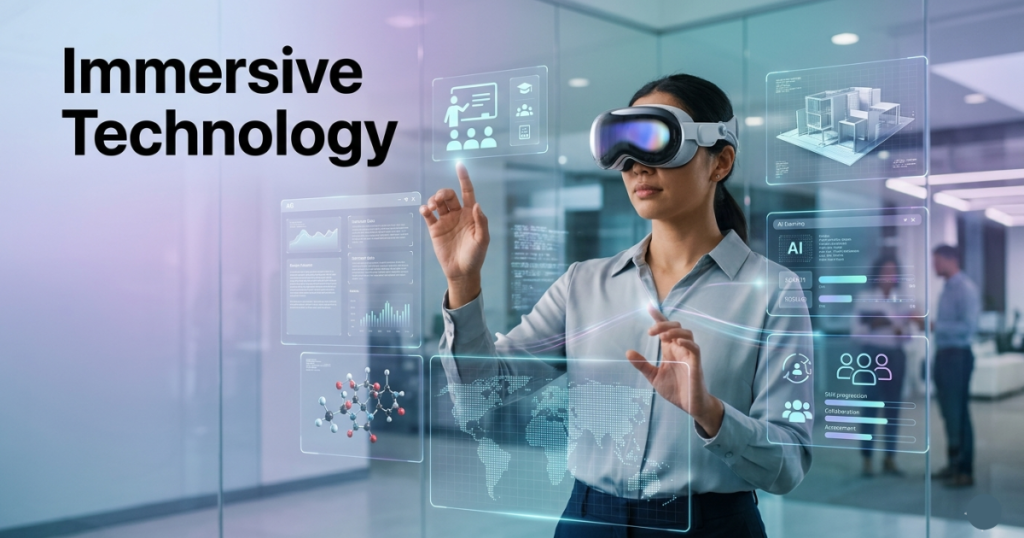
Immersive Technology is a group of digital tools that changes how a person sees, hears, feels, or interacts with a digital or digitally enhanced environment. It is designed to make users feel present inside an experience instead of only watching it on a flat screen. In simple words, Immersive Technology helps people enter, explore, and interact with virtual or mixed spaces in a more natural, realistic, and engaging way.
Today, this technology is becoming useful in many parts of life. It is used in schools, offices, healthcare, business training, gaming, retail, design, architecture, and online collaboration. Instead of only reading information or watching a video, users can now step into a simulation, move around a 3D space, view digital objects, and practice real-world tasks in a safe environment.
The main goal is to make digital experiences more active and meaningful. When people can see, hear, move, and interact, they often understand things faster and remember them better. This is why businesses, teachers, trainers, and creators are paying attention to this technology.
The most common related terms include Virtual Reality, Augmented Reality, Mixed Reality, Extended Reality, XR, VR training, AR learning, 3D simulation, virtual worlds, and immersive learning. Each term has a slightly different meaning, but all of them connect to one idea: making digital interaction feel closer to real experience.
Immersive Technology Examples: Where It Is Used Today
Immersive technology examples are now easy to find in real life. This technology is no longer only for science fiction movies or advanced gaming setups. It is already helping people learn, work, shop, train, design, and communicate.
For example, a company can use a VR training simulation to teach workers how to handle dangerous equipment. A school can use AR tools to show students a 3D model of the human body. A real estate business can offer a virtual property tour so buyers can walk through a house without visiting it physically. A hospital can use Mixed Reality to train medical students before they enter real clinical situations.
Here are some common immersive technology examples:
- Virtual Reality training for safety and skills practice
- Augmented Reality product previews for online shopping
- Mixed Reality design models for architecture and engineering
- Virtual classrooms for students and teachers
- 3D medical simulations for doctors and nurses
- Virtual showrooms for cars, furniture, and real estate
- Immersive games that let users explore digital worlds
- Remote collaboration spaces for business teams
A simple story can explain the value better. Imagine a new employee named Daniel joining a logistics company. In the past, he had to read a long training manual before entering the warehouse. He understood some parts, but many things still felt confusing. Then his company introduced a virtual training system. Daniel wore a headset and entered a digital version of the warehouse. He learned where to walk, how to avoid hazards, how to scan items, and how to respond to emergency signs. By the time he entered the real warehouse, he felt more prepared.
This is the real power of Immersive Technology. It lets people practice before real pressure begins.
5 Types of Immersive Technology: Main Forms You Should Know
The 5 types of immersive technology usually include Virtual Reality, Augmented Reality, Mixed Reality, Extended Reality, and Immersive Virtual Worlds. These types are connected, but each one creates a different level of digital experience.
Virtual Reality, also called VR, creates a fully digital environment. The user usually wears a headset that covers the eyes and places them inside a virtual space. This is useful for training, gaming, education, therapy, design, and simulation.
Augmented Reality, also called AR, adds digital content to the physical world. A user may see digital instructions, 3D objects, or visual guides through a phone, tablet, or smart glasses. AR is helpful because it does not fully remove the user from the real environment.
Mixed Reality, also called MR, blends the physical world and virtual objects more deeply. In MR, digital objects can appear as if they belong in the real space. Users may also interact with those objects.
Extended Reality, also called XR, is an umbrella term. It includes VR, AR, MR, and other reality-changing tools. Many companies use the term XR solutions when they offer a complete package of immersive tools.
Immersive Virtual Worlds are shared digital spaces where users can interact with other people, virtual objects, and environments through avatars. These worlds can be used for games, meetings, events, learning, and social interaction.
Understanding the 5 types of immersive technology is important before buying or using a product. It helps you choose the right solution for your goal instead of choosing a tool only because it looks modern.
Immersive Technology in Education: How It Improves Learning
Immersive technology in education helps students learn by doing. Instead of only listening to a lecture, students can explore a 3D environment, interact with digital objects, and practice skills in a safe space. This makes learning more active, visual, and memorable.
Many students struggle with difficult ideas when they only see them in books. For example, topics like human anatomy, space science, chemistry, engineering, architecture, and history can be hard to understand from text alone. With AR and VR tools, these ideas become easier to see.
A biology teacher can show a 3D heart beating in front of the class. A history teacher can guide students through a virtual ancient city. A science teacher can let students perform a virtual experiment. A language teacher can create a realistic conversation practice scene.
This supports experiential learning, which means learning through experience. It also supports constructivist learning, where students build understanding by exploring, testing, and interacting.
A short classroom anecdote makes this clearer. A student named Ayesha always found science boring because diagrams in books felt flat and difficult. One day, her teacher used a VR headset to show the solar system. Ayesha could look around, see planets in space, and understand their movement. After that lesson, she did not just memorize the topic. She remembered the experience.
That is why immersive learning can be powerful. It turns passive lessons into active discovery.
Immersive Technology Course: What Students and Professionals Can Learn
An immersive technology course is useful for students, teachers, developers, designers, business owners, and professionals who want to understand or build immersive experiences. Since this field is growing, learning these skills can open new career and business opportunities.
A beginner-level immersive technology course may explain the basic meanings of VR, AR, MR, and XR. It may also teach how these tools are used in real industries. More advanced courses may include 3D design, game engines, simulation development, spatial computing, user experience design, and project planning.
Common topics in an immersive technology course may include:
- Virtual Reality development
- Augmented Reality design
- Mixed Reality experiences
- 3D modeling and animation
- Unity or Unreal Engine basics
- XR project planning
- Simulation design
- User experience for immersive platforms
- Data privacy and safety in immersive systems
For professionals, a course can also explain how to use this technology in a business setting. For example, a training manager may learn how to create better employee training. A teacher may learn how to build virtual lessons. A designer may learn how to present 3D models to clients. A business owner may learn how to use AR product demos to improve customer confidence.
If you are planning to buy an immersive product, learning the basics through a course can also help you make a better decision. You will understand what type of solution you need, what features matter, and what questions to ask before spending money.
Immersive Technology Company: How to Choose the Right Provider
Choosing the right immersive technology company is one of the most important steps if you want to invest in this field. A good provider should not only offer exciting hardware or software. It should understand your goal, your users, your budget, and your long-term needs.
Before choosing an immersive technology company, ask yourself a few simple questions. Do you need training software? Do you need a product demo? Do you need a virtual showroom? Do you need an education tool? Do you need a custom simulation? Do you need support after purchase?
A reliable provider should help you choose between VR, AR, MR, or a complete XR solution. It should also explain the hardware requirements, software setup, content options, privacy settings, and support process.
Look for these qualities before buying:
- Clear understanding of your industry
- Strong examples or case studies
- Easy-to-use software
- Good customer support
- Secure data handling
- Custom content options
- Scalable product plans
- Training for your team
- Clear pricing
Do not buy only because a product looks impressive. Buy because it solves a real problem. For example, if your team needs safer practice, choose a provider with strong VR training experience. If your customers need better product previews, choose a provider that understands AR shopping experiences.
A good Immersive Technology product should make work easier, training better, learning clearer, or buying decisions more confident.
Immersive Technology Jobs: Career Opportunities in a Growing Field
Immersive technology jobs are growing because more industries are using VR, AR, MR, and XR tools. This field needs both creative and technical people. It is not only for coders. Designers, teachers, artists, project managers, trainers, writers, and business experts can also find opportunities.
Common immersive technology jobs include:
- VR developer
- AR developer
- XR designer
- 3D artist
- Unity developer
- Unreal Engine developer
- Simulation designer
- Immersive learning specialist
- Technical trainer
- Product experience designer
- Virtual world designer
- UX designer for immersive platforms
People interested in immersive technology jobs should build a mix of skills. Technical skills may include programming, 3D modeling, game engine development, and spatial design. Creative skills may include storytelling, visual design, animation, and user experience. Business skills may include project planning, training strategy, product presentation, and client communication.
The good thing is that beginners can start small. They can learn basic 3D design, try simple AR tools, explore VR platforms, take an online course, and build small practice projects. Over time, these small steps can lead to strong career opportunities.
As schools, hospitals, companies, and entertainment brands continue to adopt immersive tools, demand for skilled people is likely to increase.
Immersive Technology Mod: What It Means in Gaming and Simulations
An immersive technology mod usually means a modification that makes a game, simulation, or digital environment more realistic, interactive, or engaging. The word “mod” is common in gaming. It means users or developers change something in a game to add new features, better visuals, improved movement, new tools, or deeper interaction.
In simple words, an immersive technology mod improves the experience. It may add realistic lighting, better sound, new objects, advanced controls, VR support, or more natural movement. In some cases, mods can turn a normal digital experience into something much more immersive.
This matters because gaming has helped many people understand immersive experiences. Many users first experience virtual worlds through games before seeing the same ideas in education, business, or training.
For example, a construction safety simulation may use ideas similar to a game mod. It may add realistic machines, weather effects, danger zones, and worker movement. A medical training simulation may add better 3D body models. A driving simulator may add real road conditions.
So, while the term immersive technology mod is often linked to gaming, the idea behind it is useful in many industries. It shows how digital environments can be improved to feel more practical, realistic, and useful.
Immersive Technology Minecraft: How Minecraft-Style Worlds Support Learning
Immersive technology Minecraft is an interesting topic because Minecraft-style digital worlds are strongly connected with creativity, building, teamwork, and exploration. Minecraft itself is known as a game, but the learning style behind it is useful for education and digital creativity.
In Minecraft-style environments, users can build structures, explore spaces, solve problems, and work together. This makes it a good example of how virtual worlds can support active learning.
Students can use similar environments to build historical cities, create science models, design ecosystems, practice teamwork, and learn basic coding logic. Teachers can use these spaces to make lessons more interactive.
For example, a group of students may be asked to build a sustainable city in a digital world. They must think about roads, homes, water, energy, green spaces, and public services. This activity teaches design, planning, teamwork, and problem-solving at the same time.
This is why immersive technology Minecraft topics are useful for schools, educational creators, and parents. They show that learning does not always need to feel boring. When students build and explore, they often stay more engaged.
Minecraft-style learning also connects with the larger world of Immersive Technology, where users learn through experience instead of only reading or watching.
How Immersive Technology Works
Immersive Technology works through a combination of hardware, software, sensors, data, and real-time processing. The system collects information from the user or environment, processes that information, and then creates a digital response.
For example, when a user wearing a VR headset turns their head, the system tracks that movement. Then it updates the image instantly so the user feels like they are looking around inside a real space. If the system is slow, the experience feels uncomfortable. If it is smooth, the user feels more present.
Common hardware includes:
- VR headsets
- Smart glasses
- Hand controllers
- Motion sensors
- Cameras
- Haptic devices
- Tablets and smartphones
Common software includes:
- Rendering engines
- 3D modeling tools
- AI algorithms
- Object recognition software
- Voice recognition tools
- Simulation platforms
- Learning management systems
Many systems also use data such as head movement, hand movement, voice commands, position, room layout, and user actions. This data helps the system respond naturally.
Artificial intelligence can make the experience even smarter. AI can help recognize objects, create virtual scenes, track user performance, personalize learning, and support digital assistants.
This is why modern immersive experiences feel more advanced than simple 3D videos. They respond to the user in real time.
Benefits of Immersive Technology for Businesses
Businesses invest in Immersive Technology because it can improve training, reduce costs, support remote work, and create better customer experiences. It is especially useful when real-world training is expensive, risky, or difficult to repeat.
One of the biggest benefits is better employee training. A worker can practice a task many times inside a simulation. Mistakes do not cause real damage. Trainers can track performance and give feedback. Employees can repeat the lesson until they improve.
Another benefit is cost saving. Traditional training may require travel, physical equipment, printed materials, and instructor time. A digital simulation can be reused many times. This can make training more scalable.
It can also improve safety. Workers can experience dangerous situations without facing real danger. For example, fire safety, machine operation, emergency response, and construction hazards can be taught through virtual practice.
Businesses can also use immersive tools for sales. A customer who sees a product in 3D may feel more confident before buying. A virtual showroom can help people explore products from anywhere. An AR product preview can reduce doubt because the customer can see how something may look in their own space.
If your company wants better training, stronger engagement, or more modern customer experiences, buying an Immersive Technology product can be a smart investment.
Benefits of Immersive Technology for Healthcare
Healthcare is one of the strongest areas for Immersive Technology. It can support medical training, therapy, rehabilitation, patient education, and remote care.
Medical students can study anatomy with 3D models. Doctors can practice procedures in simulations. Nurses can train for patient care situations. Therapists can use VR exercises to help patients recover movement. Patients can use immersive content to understand treatments better.
One important benefit is safe practice. In healthcare, mistakes can have serious results. Simulations allow learners to practice before working with real patients. This does not replace real clinical experience, but it can help prepare learners.
Another benefit is repeatability. A student can practice the same procedure many times. A teacher can review performance. The system can record progress.
For patients, immersive tools can make healthcare easier to understand. A patient may feel less afraid when they can see a simple 3D explanation of a treatment.
This makes VR medical training, AR healthcare guidance, and Mixed Reality anatomy tools valuable for the future of medical education and care.
Read About: Mind Robotics: The AI-Native Robotics Company Transforming Modern Manufacturing in 2026
Step-by-Step Guide to Buying an Immersive Technology Product
Buying an Immersive Technology product becomes easier when you follow a clear process. Do not start with the device. Start with the problem you want to solve.
Step 1: Define Your Goal
Ask what you want to improve. Is it employee training, student learning, customer experience, design review, safety practice, or remote collaboration?
A clear goal helps you avoid wasting money on the wrong product.
Step 2: Choose the Right Type
Choose VR if you need a fully digital simulation. Choose AR if you want digital information over the real world. Choose MR if you want physical and virtual objects to work together. Choose XR if you need a complete mixed solution.
Step 3: Check Hardware Needs
Find out what devices are required. Some products need headsets. Some work on phones or tablets. Some need smart glasses, controllers, or sensors.
Check comfort, battery life, screen quality, and ease of use.
Step 4: Review the Software
The software should be simple, stable, secure, and easy to update. If it is for training, it should include progress tracking and feedback.
Step 5: Study the Content Quality
Content matters more than fancy hardware. A good simulation should feel useful, clear, and connected to real goals.
Step 6: Check Data Privacy
Ask what data is collected, where it is stored, and how it is protected. Choose a provider that explains privacy clearly.
Step 7: Start Small
Begin with a small pilot project. Test it with a few users. Collect feedback. Measure results. Then decide if you want to expand.
Step 8: Train Your Team
Teach users how to wear devices, use controls, follow safety rules, and report issues.
Step 9: Measure Results
Track training time, confidence, performance, safety improvement, customer engagement, or cost saving. This helps you understand the real value of your purchase.
Data Privacy and Safety in Immersive Technology
Data privacy is very important in Immersive Technology because these systems can collect more information than normal websites or apps. They may collect movement, voice, hand gestures, eye direction, location, room layout, and behavior inside a digital space.
Some of this data is needed for the product to work. For example, a headset must track head movement to update the view. An AR app may need camera access to place digital objects. A training platform may need performance data to show progress.
However, users should know what is collected and why. Businesses should choose products with strong privacy controls, clear consent options, secure storage, and transparent policies.
Safety is also important. Users should have enough physical space when using headsets. Sessions should not be too long for beginners. Clear instructions should be given before use.
A trustworthy provider will guide you on privacy, comfort, and safe usage.
Why You Can Buy Immersive Technology with Confidence
You can buy Immersive Technology with confidence when you choose it for the right reason. The goal is not to buy something only because it looks modern. The goal is to solve a real problem.
If your employees need better training, a simulation can help. If your students need more visual learning, VR or AR can help. If your customers need product confidence, a virtual demo can help. If your design team needs better review tools, mixed reality can help.
A good product can support:
- Faster learning
- Better engagement
- Safer practice
- Lower training costs
- Stronger customer confidence
- Better remote collaboration
- More memorable experiences
Before buying, make sure the product is easy to use, secure, supported, and suitable for your industry. Also make sure the provider offers training and after-sale support.
When chosen carefully, this technology is not just an expense. It becomes an investment in better learning, better work, and better customer experience.
For deeper background on how these tools work and what risks may matter, you can read this helpful explainer from the Ada Lovelace Institute.
Future of Immersive Technology
The future of Immersive Technology looks strong because people want digital experiences that feel more natural. Flat screens will not disappear, but more tasks will include 3D spaces, virtual simulations, AR guidance, smart glasses, digital twins, and AI-powered avatars.
In education, students may attend more virtual labs and field trips. In business, teams may meet inside 3D workspaces. In healthcare, doctors may use more simulation-based training. In retail, customers may preview products before buying. In architecture, clients may walk through buildings before construction begins.
Artificial intelligence will also improve immersive systems. AI can help create virtual content faster, personalize training, recognize objects, and support natural conversation inside digital spaces.
Still, the future should not be about replacing people. It should be about helping people learn better, work safer, and make clearer decisions.
FAQs About Immersive Technology
1. What is Immersive Technology in simple words?
Immersive Technology is digital technology that makes users feel part of a virtual or digitally enhanced experience.
2. What are the main types of Immersive Technology?
The main types are Virtual Reality, Augmented Reality, Mixed Reality, Extended Reality, and Immersive Virtual Worlds.
3. How is Immersive Technology used in education?
It is used for virtual field trips, 3D lessons, lab practice, skills training, and visual learning.
4. Can businesses use Immersive Technology for training?
Yes. Businesses use it for safety training, employee onboarding, customer service practice, and technical simulations.
5. Is Immersive Technology worth buying?
Yes, if it solves a real problem, improves learning or training, protects data, and fits your budget.
Conclusion
Immersive Technology is changing how people learn, work, train, shop, and communicate. It makes digital experiences more interactive, visual, and memorable. From immersive technology examples in healthcare and business to immersive technology in education, courses, jobs, Minecraft-style learning, and virtual simulations, this field is growing fast. If you want better engagement, safer practice, stronger learning, and more confident customers, now is a smart time to explore a trusted product that fits your goals and supports your future growth.

Ali Hamza Lali is the Founder and Chief Administrator of TechDoAction. A digital strategist with a background in web infrastructure and emerging technology, he built the site’s Lifestyle Tech and Tutorials section, helping readers navigate everyday tech through practical guides. He now also leads Smart Home Gadgets hands-on testing the devices that make modern living safer and smarter. When he isn’t managing site operations, Ali shares expert commentary on digital trends and home automation.