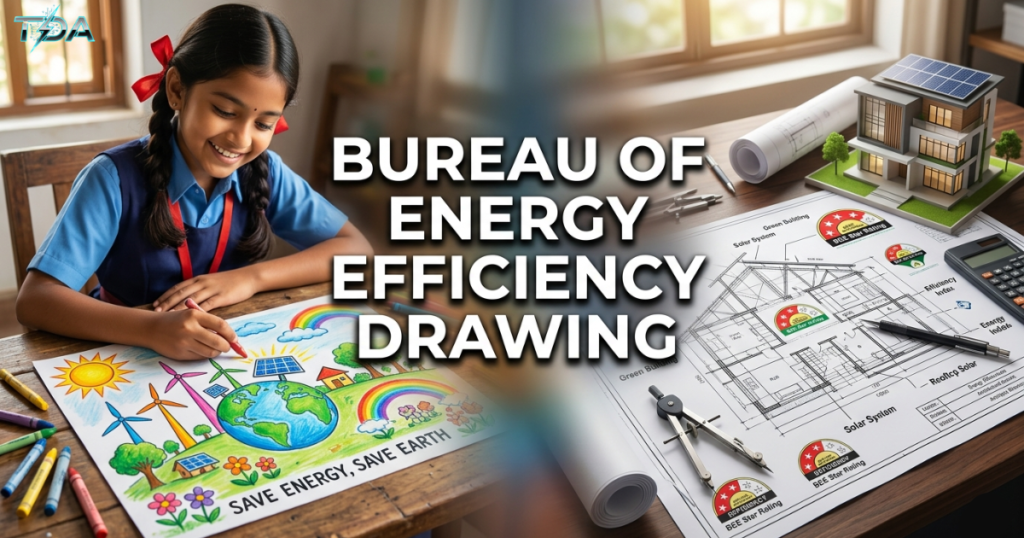
Last year, an incredible surprise awaited everyone from the hands of my neighbor’s daughter, who had won at the state-level drawing contest. The topic was energy conservation. Her drawing showed her own colony—but transformed. Every rooftop had solar panels. Every window caught the breeze just right. Her father, a civil engineer, looked at that child’s drawing and realized something. His next construction project would follow those same ideas. That is how a simple Bureau of Energy Efficiency drawing, in this case, a child’s artwork, changed the way a professional thought about building.
The phrase “Bureau of Energy Efficiency drawing” actually means two different things. One meaning takes you to school auditoriums filled with children and crayons. The other takes you to architects’ studios, where technical pens trace out building sections and AC layouts. Both lead to the same place, an India that uses energy more carefully.
What Exactly Is the Bureau of Energy Efficiency?
Walk into any electronics shop in India. You will see those star labels on refrigerators, ACs, and ceiling fans. Five stars mean excellent efficiency. One star means… maybe look at other options. That star system comes from the Bureau of Energy Efficiency (BEE).
They started in 2002 under the Ministry of Power. Their job is simple make sure India does not waste energy. They create policies. They run awareness programs. They set standards for everything from factory motors to home appliances. The Energy Conservation Act of 2001 gave them the power to do this.
The Two Meanings of “Bureau of Energy Efficiency Drawing”
Here is where it gets interesting. The same phrase means two completely different things. Let me explain both.
Meaning 1: The Creative Side BEE Drawing Competitions
My cousin teaches at a government school in a small town. Every year around October, her classroom turns into an art studio. Children sit on the floor, bent over drawing sheets, concentrating hard. They are preparing for the National Painting Competition on Energy Conservation.
This competition is huge. Millions of children from Classes 4 to 9 participate every year. The themes change but always come back to energy—”Save Energy, Save Earth,” “Renewable Energy for a Brighter Tomorrow.”
Why drawings? Think about it. A lecture about energy saving might bore a child. But when that same child draws the Earth smiling because people switched to solar power, the message sticks. It stays with them. And when they go home and tell their parents, the message spreads further.
How the competition actually works:
- School registration happens through state agencies like EDMI. Teachers spend a few days explaining simple stuff—why LED bulbs are better, how solar panels work, and why we should not waste electricity.
- The drawing day arrives. Children bring their paint boxes, crayons, and pastels. Some draw futuristic cities with windmills. Others show split images wasteful past versus an efficient future. I once saw a drawing showing a light bulb with a tree growing inside it. Simple but powerful.
- Judging happens at multiple levels. Teachers pick school winners. These go to state competitions. State winners travel to Delhi for the national event. The BEE website publishes guidelines so everyone knows what judges look for—creativity, clear message, sticking to the theme.
- Winners get serious recognition. Cash prizes up to ₹1,00,000. Trophies. Certificates. Their artwork was displayed at National Energy Conservation Day events. I have seen winning drawings framed in government offices years later.
What children actually take away: My neighbor’s daughter, the one who won the state, now switches off lights every time she leaves a room. She checks if phone chargers are unplugged. She asked her parents to install a solar water heater. The competition changed how she lives. That is the whole point.
Meaning 2: The Technical Side BEE-Compliant Design Drawings
Now let me switch gears completely. For architects, engineers, and builders, a Bureau of Energy Efficiency drawing means something technical. Detailed. Precise.
The architectural firm of my friend operates from Bangalore. A client requested my friend to create office building designs that would meet green certification requirements. My friend had to learn an entirely new way of drawing. His blueprints now required him to include elements that he previously did not consider, which included U-values of walls and Solar Heat Gain Coefficient of windows, and Lighting Power Density calculations.
These drawings show how a building will meet the energy standards set by BEE. They are proof that energy efficiency was built into the design from day one, not added later.
The rulebook for these drawings is the Energy Conservation Building Code (ECBC). If you are building a commercial building in India, this code applies to you. There are stricter versions too—ECBC+ and SuperECBC—for those aiming higher.
Why the Technical Bureau of Energy Efficiency Drawing Matters?
Think about how you feel in a badly designed building. Too hot in summer. Too cold in winter. Lights that do not reach corners. AC that runs constantly but never quite works right. That happens because nobody thought about energy when drawing the plans.
A proper BEE-compliant drawing prevents all this. It treats the building like one system. The walls, windows, AC, and lights—all work together.
Key Components of a BEE-Compliant Drawing
I sat with my architect friend one evening. He walked me through his ECBC compliance drawings. Here is what they include:
- Building envelope details: Every wall and roof gets specified with insulation thickness, materials, and target U-values. The number shows the measurement of heat transfer through materials. The system achieves optimal performance with its lowest possible value. The drawing displays both air barriers and vapor retarders, which people commonly overlook.
- Windows and glazing: This section made me realize how little I knew about windows. The drawings specify glazing type (single, double, or triple-pane) and the Solar Heat Gain Coefficient (SHGC). The measurement determines the actual amount of solar radiation that passes through glass. The drawings show shading devices, which include overhangs, fins, and louvers that protect against intense sunlight while allowing natural light to enter.
- HVAC systems: AC layouts. Chiller specifications with star ratings. Insulated ductwork so cooled air does not warm up on the way to rooms. Controls through a Building Management System (BMS) sensors that adjust temperatures automatically.
- Lighting design: Calculations for Lighting Power Density (LPD). This is the maximum watts allowed per square meter. The drawing shows exactly where each light goes, what type, and what controls. Occupancy sensors for corridors. Daylight sensors near windows.
- Renewable energy integration: Space marked for rooftop solar panels. Connections for solar water heating. Sometimes structural details for mounting.
Step-by-Step Guide: Creating a Bureau of Energy Efficiency Drawing Compliant
If you are planning construction, here is how professionals do it:
Step 1: Know your climate zone. India has five—hot and dry, warm and humid, composite, temperate, and cold. A building in Chennai needs a different treatment than one in Shimla. ECBC gives separate recommendations for each zone.
Step 2: Perform early energy modeling. Before finalizing anything, architects use software like eQuest or EnergyPlus. These programs simulate energy consumption based on orientation, materials, and systems. Think of it as a health checkup before construction starts.
Step 3: Develop architectural drawings with efficiency in mind. Wall sections showing insulation layers. Window schedules with U-values and SHGC. Shading devices are positioned carefully. Roof treatments specified.
Step 4: Create MEP drawings. These cover mechanical, electrical, and plumbing. AC equipment locations. Duct layouts with insulation. Lighting layouts with fixture types. Electrical room plans.
Step 5: Plan for renewables. Show solar panel locations. Include mounting details. Show connections through inverters and net meters.
Step 6: Document compliance. Prepare schedules summarizing U-values, lighting densities, and equipment efficiencies. Include simulation results. Submit to authorities or certification bodies.
Benefits of Green Building Certification
The buildings that meet the guidelines for Energy Efficiency Building Code oftentimes end up qualifying for green building certifications through the IGBC (Indian Green Building Council) or GRIHA (Green Rating for Integrated Habitat Assessment). The benefits are real:
- Lower operating costs: A commercial complex in Pune followed ECBC guidelines strictly. Their electricity bills dropped 35% compared to similar buildings. The extra construction cost was recovered in four years.
- Healthier living: Better ventilation. Better indoor air quality. Thermal comfort is maintained throughout the year.
- Increased property value: Green-certified buildings sell for more. Renters prefer them. This trend is only growing.
Challenges and How to Overcome Them
“But energy-efficient materials cost more upfront!” True. But a 5-star AC costs more than a 3-star one. Over ten years, you save money. The same logic applies to buildings. Payback period for ECBC compliance typically runs 3-5 years. After that, pure savings.
“I don’t understand all these technical terms.” You do not need to understand every detail. Hire an architect experienced in ECBC compliance. Ask them to explain your building’s Energy Performance Index (EPI) —energy use per square meter per year. Compare that with conventional buildings.
“Will this delay my project?” Not if done right. Building efficiency into the design stage is actually faster than fixing problems later. Retrofitting an inefficient building costs more and takes longer.
Why You Should Care About Bureau of Energy Efficiency Drawing
Let me bring this back to everyday life.
For families: Encourage your children to join the Bureau of Energy Efficiency drawing competition. Entry is free. The experience teaches them things no textbook can. And when they win, the recognition stays with them for years. My neighbor’s daughter still talks about her state-level win.
For homeowners: When building or renovating, ask your architect about ECBC compliance. Request to see the BEE drawing for your project. You must examine whether they have assessed building orientation and insulation materials, and their selection of lighting solutions and solar energy system capacity. The installation of energy-efficient systems requires an initial investment, which will generate substantial future energy savings. The official BEE Star Label application should be used to confirm appliance ratings before making a purchase.
For business owners: Energy-efficient buildings attract better tenants. Employees work better in naturally lit, well-ventilated spaces. Large industries can benefit from the Perform, Achieve and Trade (PAT) scheme.
For students: Participating in BEE painting competitions builds your portfolio. Some past winners have gone into environmental design careers. It starts with a drawing.
The Future of Bureau of Energy Efficiency Drawing in India
India faces a choice. Our energy demand grows every year as more homes get electricity, more offices open, and more factories start production. We can meet this demand wastefully, or we can meet it efficiently.
BEE is pushing for efficiency through:
- Stricter ECBC versions and updates to the Energy Conservation Act
- Star labeling expanding to more products
- Renewable energy integration under the National Solar Mission
- Drawing competitions are reaching more schools every year
I imagine a future where every new building in India follows ECBC. Where solar panels are as common as balcony rails. Where children grow up knowing exactly how to save energy. That future starts now, with awareness. And awareness starts with drawings—both the ones children make with crayons and the ones architects make with technical pens.
Frequently Asked Questions for Bureau of Energy Efficiency Drawing
1. Who can actually participate in the Bureau of Energy Efficiency drawing competition?
School students from Classes 4 to 9 can participate, divided into Group A (Classes 4-6) and Group B (Classes 7-9).
2. What themes do BEE painting competitions usually have?
Themes focus on energy conservation, like “Save Energy, Save Earth” and “Renewable Energy for a Brighter Tomorrow.”
3. How does a building actually get a BEE star rating?
Buildings must follow ECBC guidelines and submit detailed **BEE-compliant drawings** to certifying agencies for evaluation.
4. What is the real difference between a regular architectural drawing and a BEE drawing?
Regular drawings show structure and looks, while **Bureau of Energy Efficiency drawings** specify energy performance like insulation, window efficiency, and lighting power limits.
5. Beyond winning prizes, how do these drawing competitions help children?
They turn children into energy ambassadors who spread awareness at home and develop lifelong habits of conservation.
Conclusion: Bureau of Energy Efficiency Drawing
The Bureau of Energy Efficiency drawing—whether it is a child’s colorful painting or an architect’s detailed blueprint—carries the same message. The statement explains that we can achieve a good life without using unnecessary energy. The statement establishes that we can design comfortable houses while protecting the environment. The next generation will possess greater awareness than we currently have.
The next competition invites students to participate. You should choose your colors. Create a visual representation of your thoughts. Parents should provide support for that initiative. People should discuss their energy consumption patterns at home. Your actions should match your spoken beliefs. BEE-compliant drawings need to be requested by you from your architect when you need architectural designs. You should ask questions. You need to learn about your expenses. The BEE Star Label should be verified when you purchase appliances. The five-star rating system has a specific meaning.
The act of saving one kilowatt-hour of electricity leads to a corresponding decrease in greenhouse gas emissions. The energy-efficient buildings that India has constructed under its National Action Plan on Climate Change help the country achieve its climate objectives. Every child’s drawing plants a seed of awareness.
The next time you see a BEE star label on a refrigerator, remember the work behind it. The next time you hear about an energy competition, tell a child about it. Your construction project needs to demonstrate energy efficiency through your design documents.
Together, through art and engineering, creativity and science, we can build an India that uses energy wisely. One drawing at a time.
Also Read:5005706806: Solve the Mystery and Learn How to Block Unwanted Calls Safely.

Ali Hamza Lali is the Founder and Chief Administrator of TechDoAction. A digital strategist with a deep background in web infrastructure and emerging technology, he oversees the platform’s technical roadmap and editorial integrity. Ali Hamza is dedicated to building a high-performance tech hub that bridges the gap between innovation and implementation. When he isn’t managing site operations, he provides expert commentary on digital trends and the future of tech-driven productivity.